
Landlords face new £7,000 fines for serious property hazards

Councils in England have gained an additional power to issue financial penalties of up to £7,000 where serious hazards are found in rented properties.
The new power came into force on 22 June 2026 and forms part of the Renters’ Rights Act reforms.
It operates alongside councils’ existing powers to require repairs, restrict the use of a property, complete emergency work and recover costs.
What is a Category 1 hazard?
Councils assess property conditions using the Housing Health and Safety Rating System, usually known as HHSRS.
The system considers the likelihood that a property deficiency will cause harm and how serious that harm could be.
A high-risk hazard receiving a score of 1,000 or more is classified as a Category 1 hazard. When a council identifies a Category 1 hazard, it has a legal duty to take enforcement action.
The revised HHSRS framework came into force on 23 June 2026 and now groups potential risks into 21 hazard categories.
What types of problem can be covered?
Serious hazards may include:
Severe damp and mould.
Excessively cold conditions.
Faulty or exposed electrics.
Fire and explosion risks.
Unsafe stairs, windows or changes in floor level.
Structural instability.
Carbon monoxide and combustion risks.
Dangerous property layouts.
Inadequate sanitation or drainage.
Pest and hygiene risks.
Unsafe overcrowding.
A maintenance problem does not automatically become a Category 1 hazard. Its classification depends on the risk, likelihood and potential severity of harm.
However, landlords should not wait until an issue has been formally scored before responding.
How might a council become involved?
Council inspections can follow:
A complaint from a tenant.
Information supplied by a neighbour.
A referral from another public service.
A property-licensing inspection.
A council’s proactive inspection programme.
Evidence discovered during another investigation.
Councils can request tenancy agreements, safety certificates and other documents needed for their housing-enforcement functions.
This makes both the condition of the property and the quality of the landlord’s records important.
What should landlords do now?
Respond to reports promptly
Every repair or safety concern should be recorded, acknowledged and assessed.
Reports involving damp, loss of heating, exposed wiring, fire risks, structural movement or combustion appliances should be prioritised.
Investigate the cause
Temporary cosmetic treatment may not resolve the underlying hazard.
For example, repeatedly cleaning mould without addressing water ingress, ventilation or heating may allow the risk to return.
Use competent contractors
Electrical, gas, structural, fire-safety and asbestos concerns may require properly qualified professionals.
Keep invoices, photographs, reports and completion certificates.
Inspect the whole property
The HHSRS assessment can include the dwelling, access routes, gardens, yards, outbuildings and external structures.
A hazard may therefore arise outside the tenant’s main living space.
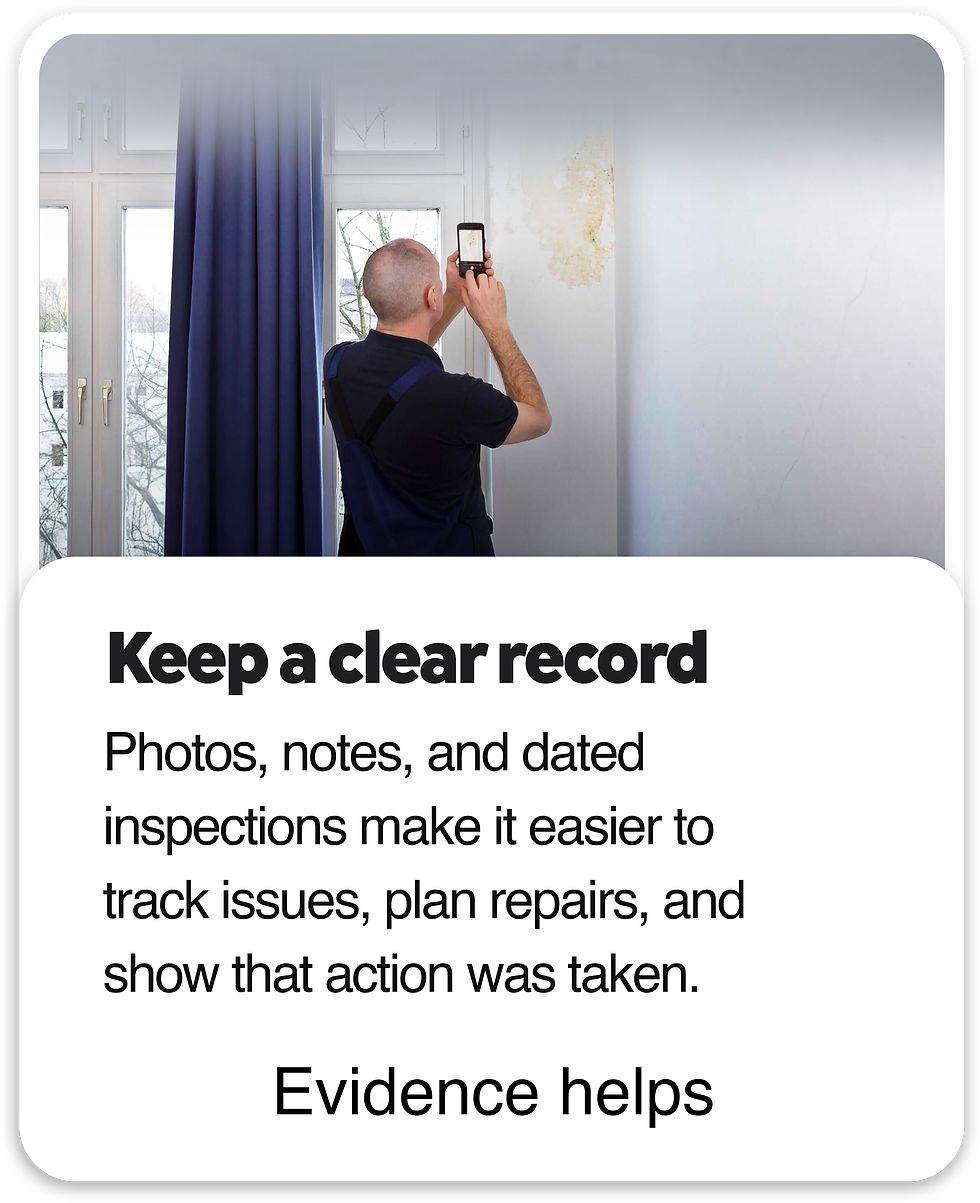
Keep an evidence trail
Record:
When the problem was first reported.
Photographs and inspection findings.
Communications with the tenant.
Contractor appointments.
Temporary safety measures.
Completed repairs.
Follow-up checks.
Good records help demonstrate that concerns were taken seriously and addressed appropriately.
Review safety documentation
Check that the property’s relevant records are current and readily available, including:
Gas-safety records.
Electrical inspection reports.
EPC documentation.
Fire-safety assessments where applicable.
Smoke and carbon-monoxide alarm records.
Property-licensing documents.
Inspection and repair histories.
Certificates alone do not prove that a property is free from every hazard, but missing or expired documents can make an already difficult situation worse.
Do private landlords need to follow Awaab’s Law?
The current Awaab’s Law timeframes apply to social rented housing rather than the private rented sector.
However, private landlords already have obligations concerning repairs, fitness for human habitation and serious HHSRS hazards. The government has stated that it intends to consult on applying Awaab’s Law to private renting.
Landlords should therefore avoid treating the absence of private-sector Awaab’s Law timeframes as permission to delay urgent work.
How CMP can help
CMP helps landlords understand what evidence is missing and which property requirement needs attention next.
Concerned about an EPC, inspection, safety record or reported property condition? Our property professionals can help you identify the appropriate next step.
Speak to CMP before a repair issue develops into an enforcement matter.
Official sources
GOV.UK — Crackdown on dangerous rented homes as new £7,000 fines kick in
GOV.UK — Landlord and agent guide to the Housing Health and Safety Rating System
This article provides general information for landlords in England and does not constitute legal or technical advice. Property hazards must be assessed according to the circumstances of the building and its occupants. Use appropriately qualified professionals where required.


Comments